A few years ago, an interior designer's digital visibility could be reduced to one fairly simple question:
“Where does my website rank on Google?”
Today, that question is becoming much more complicated.
A homeowner looking for an interior designer might search Google, check Google Maps, browse Instagram, watch a project walkthrough on YouTube, look at reviews, visit an interior design directory—and increasingly, ask an AI tool for a recommendation.
A query such as:
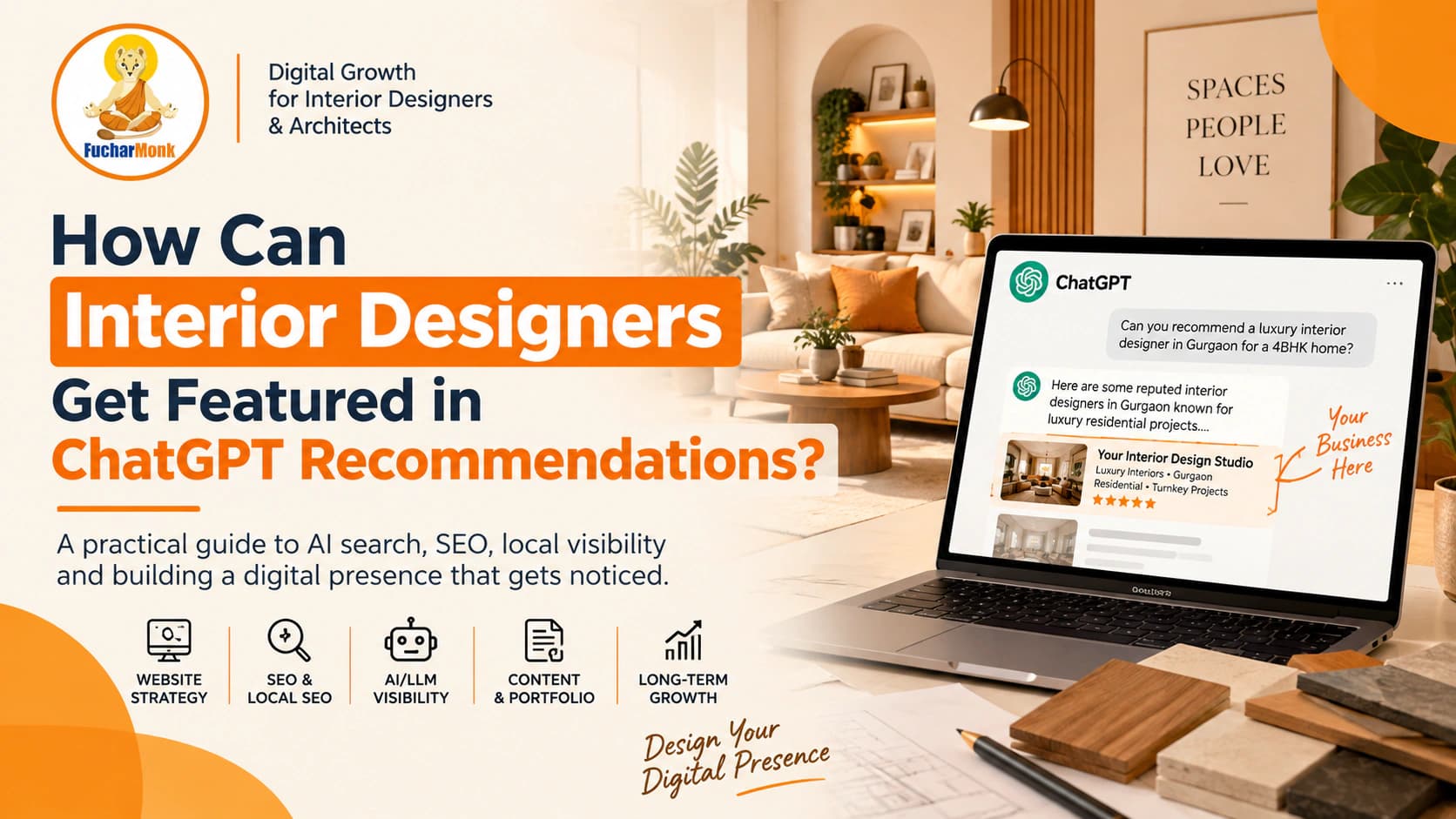
“Can you recommend a luxury interior designer in Gurgaon for a 4BHK home?”
is very different from:
“interior designer Gurgaon”
The first question requires an AI system to understand the user's intent, location, property type, service requirement and potentially the type of designer that would be relevant.
That creates a new challenge for interior designers and architects:
How do you build a digital presence that search engines and AI systems can clearly understand, connect with relevant searches and recognise as a legitimate source of information about your business?
There is no secret submission form for ChatGPT, and there is no legitimate SEO technique that can guarantee a business will be recommended in every AI response.
But there is a practical way to approach the problem.
At Fucharmonk, we look at AI visibility as part of a much larger digital growth infrastructure. The work starts with the website, but it extends into content, technical SEO, local search, project documentation, social media, third-party mentions, digital PR, structured data and continuous optimisation.
The goal is not to “hack ChatGPT”.
The goal is to make the business easy to discover, easy to understand and supported by meaningful evidence across the web.
So, how can an interior designer get recommended by ChatGPT?
The short answer is: build a strong digital entity around the business rather than optimising a website for one keyword or one AI platform.
AI systems can use different models, retrieval methods, sources and ranking mechanisms. That means there is no permanent “ChatGPT position” comparable to Google's traditional search rankings.
Instead, an interior designer should work on the signals that establish:
Who the business is
What services it provides
Where it operates
What type of projects it handles
What it specialises in
Which projects it has completed
What experience it has
What other websites say about it
How consistent its information is across the internet
Whether its information is current
Whether its website is technically accessible and well structured
This is where SEO, local SEO, entity optimisation, content, GEO and AI-search visibility start coming together.
A useful way to think about the process is:
Business Entity → Website → Services → Locations → Projects → Content → Evidence → Authority → AI Visibility
The important point is that these elements should not exist independently. They should reinforce one another.
AI Search Is Changing How People Discover Interior Designers
Traditional search usually begins with a keyword.
Someone might search:
interior designer in Noida
or:
luxury interior designer Gurgaon
An AI-assisted search can be much more conversational:
“I'm moving into a 4BHK apartment in Gurgaon and want a premium interior designer who can handle the complete project. Can you suggest some options?”
The second query contains considerably more information.
It includes:
Property type
Location
Service expectation
Quality positioning
Project scope
User intent
This is important because interior design is a high-consideration, location-dependent service.
A potential client usually doesn't want information about interior design in general. They want to find someone who is relevant to their project.
That makes contextual information particularly important.
A business that only says:
“We are a leading interior design company.”
is giving very little context.
A business that clearly communicates:
“We are a residential interior design studio serving Gurgaon and Delhi NCR, specialising in premium apartments, villas and turnkey residential interiors, with documented projects across specific localities.”
is much easier to understand.
That difference is at the heart of AI-search optimisation.
There Is No Traditional “Number One” Position in ChatGPT
One of the first misconceptions we need to clear up is the idea that ChatGPT works exactly like Google.
With Google, you can talk about:
Position 1
Position 5
Page 1
Impressions
Click-through rate
Search volume
AI responses are more dynamic.
Consider these queries:
“Who are the best interior designers in Noida?”
“Recommend a luxury interior designer in Noida.”
“Who specialises in 4BHK interiors in Noida?”
“Which turnkey interior companies operate in Noida?”
“I need a modern minimalist interior designer near Sector 150 Noida.”
These are related questions, but they are not identical.
An AI system may interpret the intent differently in each case and use different information when producing a response.
Therefore, AI visibility should be measured as visibility across relevant prompts and topics, not as one permanent ranking position.
This is also why Fucharmonk does not position AI/LLM optimisation as a promise of guaranteed ChatGPT rankings.
The objective is to improve the underlying digital signals that make a business more discoverable, understandable and relevant.
The First Problem: Most Interior Design Websites Are Built for Humans Alone
Interior design is a visual industry.
Naturally, designers want their websites to look beautiful.
Large photographs, videos, animations, minimal text and elegant layouts are often appropriate for the brand.
But there is a problem.
A human can look at a beautiful living room and understand its quality visually.
A search engine or AI system needs additional context.
Imagine a project page that says:
Residence – Gurgaon
and then displays 30 photographs.
It may look impressive.
But what does the page actually tell a search engine?
What type of property was it?
Was it a 3BHK, 4BHK or villa?
Was it residential or commercial?
What services were provided?
Was the project design-only or turnkey?
What style was used?
What locality was it in?
What was the client's requirement?
What materials were used?
What was the scope?
Was the designer responsible for execution?
The problem isn't that the website has too many images.
The problem is that the images aren't supported by enough contextual information.
The solution is not to remove the visual experience.
The solution is to combine the visual experience with meaningful, structured information.
At Fucharmonk, We Start With the Digital Foundation
When we work on SEO and AI visibility for an interior designer or architect, we don't begin by saying:
“Let's publish 50 blogs.”
The first question is:
Is the website capable of supporting long-term search growth?
For projects where we control the website development, our approach is to build a custom-coded, SEO-first website architecture.
The reason is simple.
An interior design business may eventually need:
Service pages
City pages
Locality pages
Service + location pages
Project pages
Case studies
Blog/insight content
FAQs
Team pages
Designer profiles
Media
Testimonials
Structured data
Lead-generation infrastructure
A website built only as a visual brochure can become difficult to scale when this information grows.
A properly planned architecture gives us more control over how these entities and relationships are represented.
Why a Custom-Coded Website Matters
A custom-coded website is not automatically better simply because it is custom-coded.
The real advantage is control over architecture.
For the Fucharmonk website architecture, the technology stack includes:
Next.js
TypeScript
Tailwind CSS
shadcn/ui
Framer Motion
PostgreSQL
Prisma
Custom Admin Panel
Nginx
PM2
Let's Encrypt SSL
VPS infrastructure
The important part isn't the technology name itself.
The important part is what the architecture allows us to do.
We can build the website around structured content, scalable page templates, service/location relationships, database-driven projects and technical SEO requirements rather than trying to force a complex growth strategy into a generic website structure.
That becomes particularly important when the website needs to scale into hundreds or thousands of genuinely useful pages.
Build the Website Around Entities, Not Just Keywords
This is one of the biggest differences between traditional keyword thinking and a more modern search strategy.
Suppose the target keyword is:
luxury interior designer Gurgaon
A basic SEO approach might create a page and repeatedly use that phrase.
A better approach starts by understanding the underlying entity.
Who is the business?
An interior design studio.
Where does it operate?
Gurgaon and potentially other parts of Delhi NCR.
What does it offer?
Luxury residential interiors.
What projects does it handle?
Apartments, villas and other premium residential projects.
What evidence exists?
Completed projects, case studies, photography, videos, client experiences and external mentions.
Who are the people behind it?
Founder, principal designer and design team.
What else is associated with the business?
Services, locations, projects, publications, social profiles and professional references.
This creates a much stronger digital identity.
Instead of thinking only:
Keyword → Page
we think:
Business → Service → Location → Project → Evidence → Authority
That structure is useful for traditional search as well as AI discovery.
Your Website Should Become a Knowledge Base About the Business
An interior designer's website should answer more than:
“What do you do?”
It should answer:
Who are you?
Where do you work?
What do you specialise in?
What type of properties do you work on?
What services do you provide?
What projects have you completed?
What design styles do you work with?
What areas do you serve?
What does your process look like?
What does turnkey service include?
What kind of clients do you work with?
What makes your approach different?
This is where data-driven content becomes important.
For example, a project record could contain:
Project: 4BHK Residential Interior
Location: Gurgaon
Property Type: Apartment
Design Style: Contemporary
Scope: Complete interior design and execution
Services: Space planning, kitchen, wardrobes, lighting, furniture and styling
Project Status: Completed
Now the project is not simply a gallery.
It is a meaningful business record.
Why Data-Driven Content Matters for AI Search
Imagine an AI user asks:
“Can you recommend an interior designer in Gurgaon with experience designing contemporary 4BHK apartments?”
Now compare two businesses.
Business A
Its website says:
“We create beautiful luxury interiors.”
Business B
Its website contains several documented Gurgaon projects, including contemporary 4BHK apartments, with detailed project information, service descriptions, case studies, photographs and videos.
The second business has created much more contextual information around the question.
This doesn't guarantee a recommendation.
But it creates a stronger digital foundation for relevance.
That distinction matters.
We are not trying to tell an AI system what answer to give. We are making the underlying information about the business clearer and more complete.
Location Is Critical for Interior Designers
Interior design is inherently local.
A homeowner generally needs someone who can actually work on the property.
That is why searches such as these matter:
Interior designer in Delhi
Interior designer in Gurgaon
Interior designer in Noida
Luxury interior designer in Gurgaon
Residential interior designer in Noida
Interior designer near Golf Course Road
Interior designer in Sector 54 Gurgaon
Interior designer in South Delhi
Location should therefore be part of the website's architecture, not something added to a page as an afterthought.
Build Service + Location Pages
A scalable architecture might connect:
Service: Luxury Interior Design
with
Location: Gurgaon
to create:
Luxury Interior Designer in Gurgaon
Another combination could be:
Service: Turnkey Interior Design
Location: Noida
to create:
Turnkey Interior Company in Noida
The same principle can be applied to relevant localities.
For example:
Interior Designer in Golf Course Road
or:
Luxury Interior Designer in Sector 54 Gurgaon
But there is an important qualification.
Location pages should exist because there is genuine business relevance—not simply because a keyword exists.
Creating hundreds of nearly identical pages with only the city name changed is not a meaningful AI-search strategy.
A good location page should contain actual information about the location, services, project types, relevant projects, FAQs and other useful context.
Go Beyond City Pages
The opportunity is not limited to:
Interior Designer in Delhi
Interior Designer in Gurgaon
Interior Designer in Noida
A sophisticated architecture can connect:
Region
→ Delhi NCR
City
→ Gurgaon
Locality
→ Golf Course Road
Service
→ Luxury Residential Interior Design
Project
→ 4BHK Residence
This creates relationships between pages.
A visitor can move from a location page to a service page, then to a project, then to a case study.
Search engines can also better understand how the content relates.
The result is a connected website rather than a collection of isolated landing pages.
Don't Confuse Programmatic SEO With Mass Page Generation
Programmatic SEO can be powerful for businesses with many locations, services or combinations.
But programmatic SEO should not mean:
Create 10,000 pages with the same paragraph and change the city name.
That produces little value.
A useful programmatic page needs meaningful variation and genuine information.
For an interior design business, that could mean:
Relevant local insights
Relevant services
Real projects
Location-specific FAQs
Local project types
Design considerations
Internal links
Business information
The objective is scale without sacrificing usefulness.
Project Pages Are One of the Biggest Opportunities for Interior Designers
Interior designers already possess something many businesses struggle to create:
Original first-party material.
Every completed project can become a content asset.
A strong project page can include:
Project Overview
Project name
Location
Property type
Size
Design style
Client Requirement
What did the client want?
Design Approach
What was the design strategy?
Scope
What services were provided?
Materials
What materials were selected?
Challenges
What problems existed?
Solutions
How were those problems solved?
Final Outcome
What changed?
Visual Evidence
Professional photography
Video walkthroughs
Before/after visuals
This transforms a portfolio from a gallery into a searchable knowledge asset.
Case Studies Can Be More Valuable Than Generic SEO Articles
There are thousands of articles online about:
“10 Modern Interior Design Ideas.”
Another article like that does not necessarily give an interior design business a distinctive voice.
Compare that with:
How We Designed a 4BHK Contemporary Residence in Gurgaon
Now the business can explain:
The client's brief
The original space
The design challenge
The solution
Materials
Layout decisions
Execution
Final result
That is first-hand information.
And first-hand information is one of the strongest content assets an interior design company has.
This is why our content philosophy favours real projects, original video, walkthroughs, transformations, case studies, designer expertise and genuine industry observations rather than repetitive generic content.
Your Services Need Their Own Content Architecture
An interior design business should not hide all of its services inside one “Services” page.
Depending on the business, separate pages may be appropriate for:
Residential Interior Design
Luxury Interior Design
Turnkey Interior Design
Commercial Interior Design
Villa Interior Design
Office Interior Design
Hospitality Interior Design
Renovation
Space Planning
Each page should explain:
What the service is
Who it is for
What is included
How the process works
Which locations are served
Relevant project examples
FAQs
Related services
This creates topical depth around the business.
Structured Data: Useful, but Not a Magic Button
Structured data is another component of the technical foundation.
Depending on the page and business, appropriate schema may include:
Organization
LocalBusiness
Person
Service
Article
Breadcrumb
FAQ, where appropriate
Structured data helps communicate information in a machine-readable format.
But it is important not to exaggerate what it does.
Adding schema does not mean:
“ChatGPT will now recommend this company.”
It doesn't work that way.
Structured data is one component within a much larger architecture involving content, technical accessibility, entity clarity, relevance and authority.
Internal Linking Helps Connect the Story
A website should not have hundreds of pages that never reference one another.
Imagine a page titled:
Luxury Interior Designer in Gurgaon
It could naturally connect to:
Luxury Interior Design
Residential Interior Design
Gurgaon Projects
4BHK Interior Design
Villa Interior Design
Interior Design Cost Guide
Relevant Case Studies
A project page could link back to:
Gurgaon
Residential Interiors
Luxury Interiors
Related projects
This creates a connected information architecture.
In simple terms:
Every important page should have a relationship with other relevant pages.
Answer the Questions Real Clients Actually Ask
AI search is conversational, so content should answer real questions.
For an interior designer, these might include:
Finding a designer
Who are the best interior designers in Gurgaon?
Choosing a service
What does turnkey interior design include?
Understanding cost
How much does a 3BHK interior cost?
Understanding the process
How does an interior designer work with a homeowner?
Location
Which interior designers work near Golf Course Road?
Project type
Who can design a luxury villa in Gurgaon?
Comparison
What is the difference between an architect and an interior designer?
Problem solving
Why is my interior project taking longer than expected?
These questions can become:
Blog posts
FAQs
Service-page sections
Location-page sections
Case studies
Videos
Social content
One useful question can therefore create multiple content assets.
First-Hand Expertise Is a Major Advantage
Interior design businesses have access to information that generic content writers don't.
They know:
What happens on site
What clients actually ask
Which materials work
Where projects go wrong
How budgets change
What design decisions matter
How execution affects design
What homeowners misunderstand
That knowledge should become content.
Instead of:
“5 living room design tips”
a designer can talk about:
“Five living-room planning mistakes we regularly see in Gurgaon apartments.”
That is more specific.
More importantly, it comes from actual experience.
Another example:
“What We Changed in a 4BHK Gurgaon Living Room to Improve Circulation”
That is far more distinctive than another generic listicle.
Social Media Is Part of the Digital Footprint
AI visibility should not be treated as a website-only exercise.
An interior designer's online presence may include:
Instagram
Facebook
YouTube
LinkedIn
Pinterest
Google Business Profile
Industry directories
Architecture platforms
Business listings
Publications
Interviews
Podcasts
The objective is not simply to create accounts everywhere.
The objective is to build a consistent digital identity.
The same business should be recognisable across platforms.
Its:
Name
Location
Services
Specialisation
Website
Project information
Areas served
should be consistent wherever practical.
Why Entity Consistency Matters
Imagine the website says:
ABC Interiors — Gurgaon
Instagram says:
ABC Interior Studio — Delhi
LinkedIn says:
ABC Design & Build
and a directory says:
ABC Designs — Noida
A human may understand that these are related.
But inconsistent information creates unnecessary ambiguity.
For this reason, Fucharmonk treats entity consistency as part of the broader visibility strategy.
The goal is to make it clear that the information across the digital ecosystem belongs to the same business.
Google Business Profile Still Matters
AI search does not make local SEO irrelevant.
For a local interior designer, Google Business Profile remains an important part of the digital ecosystem.
It should contain accurate and current information about:
Business name
Category
Location or service area
Website
Contact details
Services
Photos
Projects
Reviews
And it should be maintained.
If a business launches a new service or has new projects, its online presence should evolve accordingly.
Reviews Provide Real-World Context
Reviews are another form of business evidence.
A review saying:
“Amazing work.”
contains little contextual information.
A genuine review that naturally describes:
“They designed our 4BHK apartment in Gurgaon and handled the complete interior execution.”
provides more context.
The important word is genuine.
Reviews should never be fabricated or manipulated.
The objective is to collect authentic feedback from real clients.
Your Website Should Not Be the Only Place Your Business Exists
An interior design brand should ideally have a broader digital footprint.
Relevant sources can include:
Design directories
Architecture websites
Local business directories
Industry publications
Interviews
Podcasts
Project features
Guest articles
Digital PR
Professional profiles
This creates external references around the business.
For example, if a credible publication discusses:
“Contemporary residential projects by ABC Interiors in Gurgaon”
that is another independent reference connecting:
ABC Interiors + Interior Design + Gurgaon + Contemporary Residential Projects
The objective is not to manufacture backlinks.
The objective is to build genuine authority and visibility.
Digital PR Is About Context, Not Just Links
Traditional link building often asks:
“How many backlinks did we get?”
A stronger approach asks:
“What does this mention say about the business?”
A relevant publication feature can establish associations around:
Expertise
Location
Services
Projects
Design style
Industry recognition
That contextual relevance is more useful than collecting random links from unrelated websites.
Video Is Particularly Powerful for Interior Designers
Interior design is visual.
That makes video one of the strongest content formats available to the industry.
A single project can produce:
Project walkthrough
Designer explanation
Site visit
Before/after video
Material discussion
Room-by-room tour
Client interview
Design-process video
But the video should not exist in isolation.
Give it context through:
Meaningful title
Description
Project information
Location
Service
Website link
Related content
The video becomes another part of the same digital entity.
One Project Can Become an Entire Content Ecosystem
Imagine an interior designer completes a luxury villa in Gurgaon.
That one project can become:
Website project page
Luxury Villa Interior Design Project in Gurgaon
Case study
How We Designed a Luxury Villa in Gurgaon
YouTube video
Complete Gurgaon Luxury Villa Walkthrough
Before-and-after reel
Project breakdown
Room-wise project boards
Blog
Key Interior Design Decisions in a Gurgaon Luxury Villa
The important part is that all of these assets are connected to the same real project.
This creates depth rather than content volume for its own sake.
Keep the Digital Presence Updated
This is where many businesses stop.
They build a website, publish some blogs and then leave everything unchanged for two years.
Interior design businesses cannot afford to think this way.
Projects continue.
Services evolve.
Design trends change.
Locations expand.
The team changes.
New work gets completed.
New questions emerge.
The digital presence should reflect that.
Updates might include:
New projects
New case studies
New photography
New videos
New services
New locations
New FAQs
New insights
New team information
New client stories
The objective isn't to update pages simply to make them “fresh.”
The objective is to keep the business's digital information accurate and useful.
AI Visibility Should Be Monitored Like Any Other Marketing Channel
One of the most practical things an agency can do is create a set of realistic prompts.
For example:
“Who are the best interior designers in Gurgaon?”
“Recommend a luxury interior designer in Gurgaon.”
“Who can design a 4BHK apartment in Gurgaon?”
“Recommend an interior designer near Golf Course Road.”
“Which interior designers specialise in contemporary residential interiors in Delhi NCR?”
“Which turnkey interior companies operate in Noida?”
Then monitor the results over time.
Questions to track include:
Is the business mentioned?
Which competitors appear?
Which sources are referenced?
Which website pages are relevant?
Which services generate visibility?
Which locations generate visibility?
What information appears to be missing?
What content opportunities emerge?
This gives the SEO team a feedback loop.
Build an AI Search Content Map
A useful way to structure this is:
Entity Service Location Project Type Search Intent
For example:
Entity: Interior Design Studio
Service: Luxury Interior Design
Location: Gurgaon
Project Type: 4BHK
Intent: Recommendation
This produces a highly specific user question:
“Can you recommend a luxury interior designer in Gurgaon for a 4BHK apartment?”
Now the website can support that topic through:
Service page
Location page
Project page
Case study
FAQ
Blog
Video
External mentions
This is much more strategic than trying to rank one page for one keyword.
Technical SEO Still Matters in the AI Era
AI search does not make technical SEO obsolete.
A website still needs a strong technical foundation.
That includes:
Clean URLs
Sitemap
Robots.txt
Canonical tags
Mobile responsiveness
Fast loading
Image optimisation
Core Web Vitals
Redirect management
Breadcrumbs
Structured data
Crawlable content
For a content-heavy interior design website, performance is especially important because high-resolution photography and video can make pages heavy.
The objective is to balance:
Visual quality + performance + crawlability + usability + conversion.
Why a Database-Driven Website Can Become More Powerful
Suppose an interior designer completes a new project.
Instead of treating that project as a single page, the website can store structured information such as:
Project name
City
Locality
Property type
Design style
Services
Images
Video
Description
Completion information
That information can then connect to:
Portfolio
Location pages
Service pages
Case studies
Related projects
Internal links
This is where a database-driven architecture becomes useful.
The website starts behaving more like a knowledge system than a static brochure.
Think of the Website as a Knowledge Graph
A simplified example might look like this:
Interior Design Brand
        ↓
Interior Design Studio
        ↓
Gurgaon
        ↓
Luxury Residential Interiors
        ↓
4BHK Projects
        ↓
Specific Project
        ↓
Case Study
        ↓
Images + Video
Another relationship could be:
Interior Design Brand
        ↓
Turnkey Interiors
        ↓
Noida
        ↓
Residential Projects
        ↓
3BHK
        ↓
Specific Project
These relationships make the business easier to understand.
The website isn't merely saying:
“We are an interior designer.”
It is demonstrating:
Who we are, where we work, what we specialise in and what evidence exists to support those claims.
Don't Forget the People Behind the Brand
An interior design company is not just a logo.
The website should also communicate the people and expertise behind the business where relevant.
This can include:
Founder
Principal designer
Design team
Professional background
Specialisations
Published work
Interviews
Speaking engagements
Verifiable awards or recognition
The important word here is verifiable.
Do not invent awards, qualifications, clients or project experience simply because they might help SEO.
Trust is more important than a keyword.
Use AI to Scale Expertise, Not to Manufacture Expertise
AI tools can be useful for:
Research
Organisation
Transcription
Content structuring
Repurposing
Drafting
But there is a major difference between using AI to organise real business knowledge and using AI to produce hundreds of generic articles.
For example:
Designer interview
↓
Video
↓
Transcript
↓
Expert article
↓
FAQ
↓
Social posts
↓
Short-form video
↓
Case study
One real source of expertise can therefore become multiple useful assets.
This is much closer to the content model we recommend at Fucharmonk.
What Should an Interior Designer Actually Publish?
The strongest content opportunities usually come from the business itself.
Examples include:
Educational content
What does turnkey interior design include?
Pricing content
How much does a 3BHK interior cost?
Local content
What should homeowners consider when designing an apartment in Gurgaon?
Project content
How We Designed a 4BHK Contemporary Home in Gurgaon
Problem-solving content
Why Interior Projects Get Delayed and How to Prevent It
Expertise content
Five Layout Mistakes We Commonly See in Large Living Rooms
Comparison content
Interior Designer vs Architect: Who Should You Hire?
AI-search content
How Interior Designers Can Improve Their Visibility in AI Search
The common thread is that the content answers a real question.
The Keyword Strategy Should Be Broad, But Natural
For this topic, the keyword universe can include several closely related groups.
ChatGPT and AI Search
how to get featured in ChatGPT
how to get recommended by ChatGPT
ChatGPT recommendations for interior designers
ChatGPT SEO for interior designers
AI search for interior designers
AI visibility for interior designers
AI SEO for interior designers
LLM SEO for interior designers
LLM visibility
AI search visibility
GEO
GEO for interior designers
Generative Engine Optimization for interior designers
generative search optimization
AI search optimisation for interior designers
LLM optimisation for interior designers
AI search optimisation
generative engine optimisation
SEO
SEO for interior designers
interior designer SEO
interior design website SEO
local SEO for interior designers
entity SEO for interior designers
semantic SEO for interior designers
structured data for interior designers
schema markup for interior designers
Website
website for interior designers
custom website for interior designers
custom-coded website for interior designers
AI-friendly website for interior designers
SEO-friendly website for interior designers
interior design website development
Local Search
interior designer in Delhi
interior designer in Gurgaon
interior designer in Noida
luxury interior designer in Gurgaon
luxury interior designer in Delhi
residential interior designer in Gurgaon
turnkey interior company in Noida
interior designer near me
Authority
interior designer online presence
interior designer digital marketing
interior designer brand authority
interior designer online reputation
interior designer directories
interior designer digital PR
interior designer backlinks
interior designer citations
These should be used naturally.
The objective is not to insert every keyword into the same article.
The objective is to build a topic ecosystem where each important question has the appropriate page or content asset.
How Fucharmonk Approaches AI and Search Visibility
At Fucharmonk, the process is broader than traditional SEO.
We typically think through the following sequence.
First: Understand the business
We study:
Business model
Services
USP
Locations
Project types
Target audience
Competitors
Then: Research the market
We look at:
Search demand
Competitor visibility
Service opportunities
Location opportunities
Content gaps
Commercial intent
Then: Build the architecture
We define:
Website structure
Service hierarchy
Location hierarchy
Project structure
Internal linking
SEO templates
Then: Build the website
Where applicable, this includes:
Frontend
Backend
Database
Custom admin
Lead forms
SEO infrastructure
Then: Build the content
We develop:
Service + location pages
Project pages
Case studies
Insights
FAQs
Supporting content
Then: Build authority
This can include:
Local SEO
Google Business Profile
Relevant directories
Digital PR
Brand mentions
Industry platforms
Then: Optimise for AI discovery
We work on:
Entity clarity
Structured information
Question-answer content
Location relevance
Service relevance
Machine-readable architecture
External corroboration
And then we keep improving
We monitor:
Search performance
Content performance
Technical health
Competitor movement
New content opportunities
The important part is that this is a continuous process.
What Makes Fucharmonk's Approach Different?
Many SEO campaigns begin with:
“Send us your keywords.”
We prefer to begin with:
“Help us understand your business.”
Because keywords are only one part of the problem.
For an interior designer, we need to understand:
What type of designer are you?
Where do you operate?
What projects do you actually complete?
What services do you provide?
What type of clients do you serve?
What makes your work distinctive?
What evidence exists?
What does the rest of the internet say about you?
That information becomes the foundation for the digital strategy.
This is particularly important for Fucharmonk because our positioning is not as a generic digital marketing agency.
We work specifically around the interior design and architecture ecosystem, combining website development, SEO, Local SEO, original content, lead generation, lead qualification, nurturing and AI/LLM visibility.
That specialisation allows the strategy to be built around actual industry behaviour rather than generic marketing templates.
Can Anyone Guarantee a ChatGPT Recommendation?
No.
And this is worth stating clearly.
ChatGPT and other AI systems are controlled by their respective platforms.
Their:
Models
Retrieval systems
Data sources
Algorithms
Search behaviour
can change.
Therefore, a promise such as:
“We guarantee that ChatGPT will recommend your interior design business.”
should be treated very carefully.
A more responsible objective is:
Build and continuously improve the digital infrastructure that increases discoverability, relevance, machine understanding and authority across search and AI systems.
That is the approach we follow.
The Goal Is Bigger Than ChatGPT
It is also a mistake to build a digital strategy exclusively around one AI platform.
The same foundation can support visibility across:
Google Search
Local Search
Google AI experiences
ChatGPT
Gemini
Perplexity
Bing
Other AI-powered discovery systems
Social platforms
Industry directories
Referral websites
This is why we prefer the term:
Digital Search & AI Visibility
rather than simply:
ChatGPT SEO.
The platform may change.
The underlying principles of good digital information architecture remain useful.
What Should an Interior Designer Do Now?
If you are an interior designer or architect and want to prepare your business for AI-assisted search, start with the fundamentals.
Make sure your website clearly answers:
Who are you?
Where do you work?
What do you specialise in?
What services do you offer?
What projects have you completed?
What locations do you serve?
Who is behind the business?
Then build from there.
Create useful service pages.
Create meaningful location pages.
Document real projects.
Publish case studies.
Show first-hand expertise.
Maintain your Google Business Profile.
Keep social profiles consistent.
Build relevant external mentions.
Implement technical SEO and structured data.
Keep the website updated.
And monitor the actual questions your potential customers are asking AI systems.
The Bigger Shift: From Keywords to Entities
Traditional SEO taught businesses to think:
Keyword → Ranking → Click
The search environment is becoming more contextual.
A more useful framework is:
Entity → Context → Relevance → Evidence → Authority → Discovery
For an interior designer, the internet should make it easy to understand:
Who you are
↓
What you do
↓
Where you operate
↓
What you specialise in
↓
What projects you have completed
↓
What clients say about you
↓
Where you have been mentioned
↓
What expertise you demonstrate
↓
Whether your information is current
That is the real foundation of AI visibility.
Final Thoughts
Getting featured in ChatGPT recommendations is not about discovering a secret trick.
It is not about publishing hundreds of AI-generated blogs.
It is not about repeating “best interior designer” across every page.
And it is not about buying random backlinks.
It starts with building a strong digital presence around the business itself.
For an interior designer, that means combining:
A custom, technically strong website
with
clear service architecture
location-based content
data-driven project pages
case studies
structured data
technical SEO
Local SEO
Google Business Profile
social media
third-party mentions
digital PR
first-hand expertise
regular updates
and
ongoing AI/LLM visibility monitoring.
The objective is simple:
Make the business easy for people to find and easy for machines to understand.
No agency can control what an AI system will recommend for every user.
But a business can control the quality, consistency, depth and authority of the information it puts into the world.
And that is where the real opportunity lies.
At Fucharmonk, we don't see the future of search as simply Google versus ChatGPT.
We see it as a broader digital discovery ecosystem where websites, search engines, AI systems, social platforms, local profiles, projects, reviews and third-party sources all contribute to how a brand is discovered and understood.
The businesses that build that ecosystem deliberately will be better prepared for how customers discover services next.